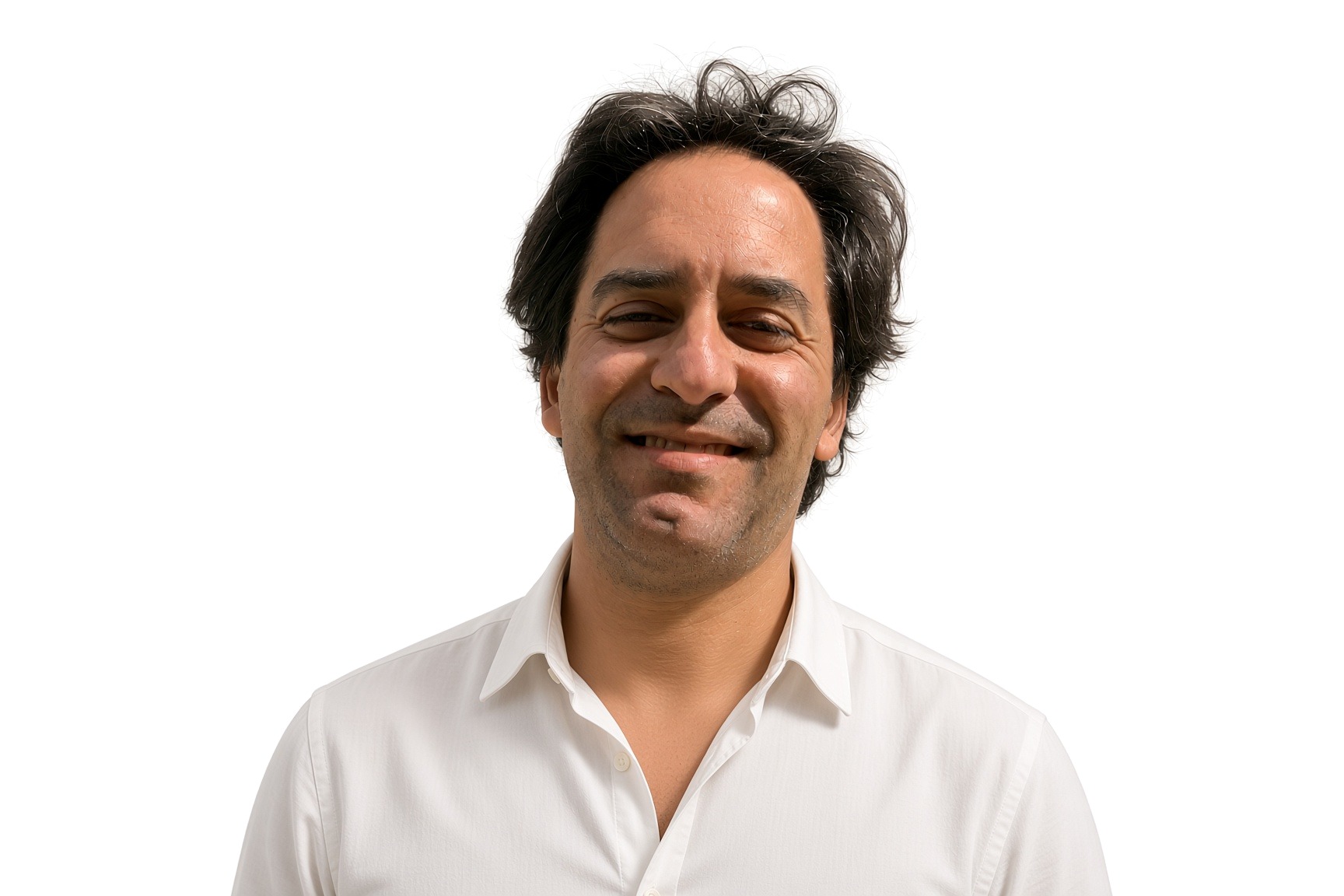
Lisandro Gallardón
Poetry mentor
Degree in Philosophy from the University of Buenos Aires, with honors. Training in Letters. More than twenty years in poetry. He passed through the House of Poetry and through Oxford. He joins spiritual accompaniment with a precise method for reading poems and for developing compositional thought.
My story
I did not start writing to become a writer.
My story does not begin with a vocation, or with a talent. It begins with an early, persistent feeling: of not being safe.
At three I lived through things my body remembers before my memory does: a girl holding me under the water until I was drowning, a leg caught in a hole full of ants, a stone hitting my head, being left in a garden crying alone. I also remember a bag of sweets I had worked for on Halloween, which my mother threw away with no explanation. I did not understand why. Something stayed: my effort was worth nothing.
For years the world was hostile and unpredictable. And yet it was also the place where the first crack of meaning appeared.
When I was seven, my mother took me on weekends to my grandparents' house. At the back of the garden there was a small room and a makeshift workshop. My grandfather worked there for hours. I was beside him, putting things together, testing, taking them apart, starting again. I was not making “toys”. I was exploring. I built for the sheer impulse to build.
The garden had fruit trees. I remember the plums especially: red, fragrant, so large they filled my whole hand when we picked them together. In the morning we had breakfast early. In the afternoon my grandfather napped. Everything was simple, quiet, real.
One afternoon, waiting for him to wake so we could go back to the workshop, I sat in front of the television. In an old series an old man appeared, head shaved, in a robe, talking to a child who held a candle. They spoke of the mystery of life, of consciousness, of compassion. I felt, with a clarity I cannot explain, that the old man was my grandfather and the child was me. I stayed still for a whole hour, without blinking. Something opened. Without knowing it, I was entering an inner world that would never leave me.
The next day I went to school and everything looked different. I wanted to live from there. When the other children tried to bother me at recess, I did not answer with violence. I answered with presence. From then on I never fought with anyone again. I felt I had touched something true. I believed I could change the world by living from that place.
I was a brilliant student. I trained in swimming, studied piano, wrote poetry, wanted to be a philosophy teacher. I read without stopping. I learned on my own what the school did not know how to give. But the real difficulty was not in the books or the achievements. It was at home.
My mother was deeply depressed. She had always been my support, and I felt it was now my turn to save her. Every afternoon after school we talked for hours. I spoke to her of her beauty, her talent, her goodness. I tried to give her meaning back. She smiled, said “thank you, I love you”, and went out to face the day with a little more light. I was her lifeline. She was my best friend.
Until one night I came home and found her dying.
At three in the morning I was covered in blood, on the floor, trying to revive her. My mother died naked, as at birth, in my arms. I felt her last breath leave her body like a balloon going flat. I gave her mouth-to-mouth. Her heart was no longer beating. She died of cancer. And in that instant something in me died too.
My whole system of beliefs collapsed. If years of reflection, spirituality, and love had not been able to save her, then what was any of it worth? I felt cheated. Empty. Guilty. I believed I did not deserve to enjoy anything again.
For a long time I lived with a false premise: if I could not save my mother, my message is worth nothing.
I tried then a “normal” life. I committed to a relationship, bought an apartment, finished my degree, worked as a teacher. Then I separated. I got a good job. I studied for a master's. But the freedom was external. Inside I was still empty.
When everything falls apart
I went to Oxford looking for something I could not name. I worked inside the university as a barista and a supervisor, behind a counter. I made coffees without stopping, at an exhausting pace. On the other side were the professors and the students. I listened to them talk about books, classes, ideas. While I frothed the milk I thought: one day I will be there. I dreamed of crossing that counter. But to them I was only the one who served the coffee.
I lived near my dream, but not inside it. I read poems at events. A tutor praised one of my creative tools. I was invited to tea. I thought that was the beginning. It was not. I felt invisible. Not enough.
I was alone, in another country, with no one to hold me. There were days I did not leave the room. I urinated in a bottle so I would not have to face the world. The washing machine frightened me. I ate badly. I watched series without stopping. I took refuge in silent vices. I felt dead, but breathing.
Until one day I went out. I walked with no direction until I reached the river. I saw the birds fly. The ducks come down to the water. The reflection of the sun. Beauty existed, even without me. I sat there, without hope, without meaning, only as a witness. I wrote without looking for a meaning. And something changed.
It was not happiness. It was not relief. It was a deep neutrality. Presence. Lucid emptiness.
I understood that no one can live for you what you yourself have to go through. That nature is a complete teacher. That you do not need a university in order to learn in the university of ordinary life. That to control the mind, to give thanks, and to know yourself is an infinite investigation.
The inner teacher
That night I dreamed of my mother. I saw a chessboard. She was a queen turned into a pawn on my father's board. And I understood something essential: my father was not only to blame. He had also inherited a way of seeing the world. He did good things for me. He helped me. And today I can see them.
My mother's sadness was not her essence. It was the position she occupied. I did not have to imitate her sadness in order to love her.
I woke free.
I understood this:
- I did not fail by helping her.
- My message did not lose its worth.
- I am not responsible for other people's decisions.
- Poetry is not sadness. It is vulnerability, and the joy of becoming.
I packed and went back.
I stopped looking for permission from outside. I decided to investigate on my own. To share what I found. To live, and to inspire.
I founded Laboratorio del Poeta. My students won prizes. They published books. Some studied with me for more than six years. They said my classes changed their lives. Teachers watched the method. I built a community, a team, a channel. I learned to live from poetry. I learned to live alone. To be my own best friend. To feel a friendship with the universe.
Today I live given over to the research, the writing, and the students. I work online. Every morning I walk to the park. I meditate. Then I sit in a café to study, to think, to write, and to turn what I find into tools for other people. I am preparing a doctorate on the methodology of poetic creation, from a scientific and formal approach.
I do not teach people how to save themselves. I teach them to unfold their own intensity. To wake the inner teacher. To inhabit their own voice. To find beauty and truth in ordinary life. To make possible worlds, in order to understand themselves and to say what they are.
My life is no longer a personal story. It is a simple aim: to live with depth, and to help others unfold what they already are.

How I see a poem
Explore like a poet. Build like an engineer.
Every poem is a machine made of words: what it makes is ideas and feelings. Here you learn to feel it, understand it, fix it, moving from meaning to syntax, from image to sound.
You read with sensitivity. You compose with logic. You write with feeling.
How I see poetry
To make a poem is to follow.
It is not to invent. It is not to transform. It is to follow.
Follow the thread of what is real, outside you and inside you, and do not let go. You do not have to add anything. You go to meet it, and you let the difference appear.
A glass, four energies
A glass has a circle, an emptiness, a transparency, and a way of being carried. Each attribute can stay a fact, or become an expressive vibration.
From the emptiness: “I placed my thirst, my fatigue, in a broken glass.”
From what can be carried: “I gave my love to everyone the way one offers a glass of water.”
Readings to begin
Four short readings. Then the object is yours.
- Blake, “Auguries of Innocence”. How much of the world fits in one small thing, if you follow it.
- Yeats, “He wishes for the Cloths of Heaven”. The thread, held, not invented.
- Wordsworth, “My Heart Leaps Up”. What is already there, before a word is added.
- Blake, “The Sick Rose”. Poetry moves between what is seen and what is said.
How it is practiced
- Choose a simple object and describe its properties.
- Connect them with an abstract noun that weighs in your life.
- Then move to small processes: boiling, raining, being born, a leaf falling.
In their words
Estela Zanlungo · poet, Argentina. Fondo Nacional de las Artes Prize, 2014.
I met Lisandro at the Poetry Clinic of the National Library, where we were fellow students. When it ended, we agreed to meet every two weeks to work on my book, which I planned to send to the Fondo Nacional de las Artes competition. For months we spent many Sunday afternoons in a small bar in Lomas, reading, rereading, and analyzing poems, until night came without our noticing. Time flew.
To stand before one’s own texts in the light of another poet’s eye is absorbing work. It enriches the text, and it makes the hard decisions easier.
Lisandro has a solid academic training, which matters when you are revising your own work. But it is his very fine sensitivity, and his generosity, that made the work a pleasure as well.
Soñar con Agua won first prize, and was published by Ediciones del Dock at the beginning of 2014. In the closing words, beside the names of my teachers, is Lisandro’s. My book, and I, owe these lines to his passion.
He saw things in my poem that I did not see. The text came to have another value. When he speaks, you feel that he lives what he says, and that gives confidence.
Salvador · individual mentorship
I was there for more than six months, two classes a week. The work was to strengthen the imagination: to join different realities and give them a poetic character.
Simón · group, then individual mentorship
It changed how I edit. I look at the original poem, the revised one, and the changes, and I read it aloud, not only in my head.
Esteban Morales · individual mentorship
Over six years I learned to work the language so the line says more precisely what it means, and I came to lead a poetry writing group.
Carolina · six years of private mentorship
I did not know exactly what I wanted. He helped me find an aim: to write my life.
Laura · individual mentorship
A poem that began at The Poet's Lab is in my book, La balada del cordero.
Javier Villamonte · individual mentorship
Over three years I learned to see more clearly what I had only sensed. Each revision found another layer.
Sara Luisa · three years of private mentorship
The classes helped me improve the texts I already had, and see things in the poem I had not seen.
Eduardo · individual mentorship